Rosa Vogel · 4 November 2026
Satellite Imagery Uncovers Shifts in Mint Yields Throughout Eastern European Agricultural Zones
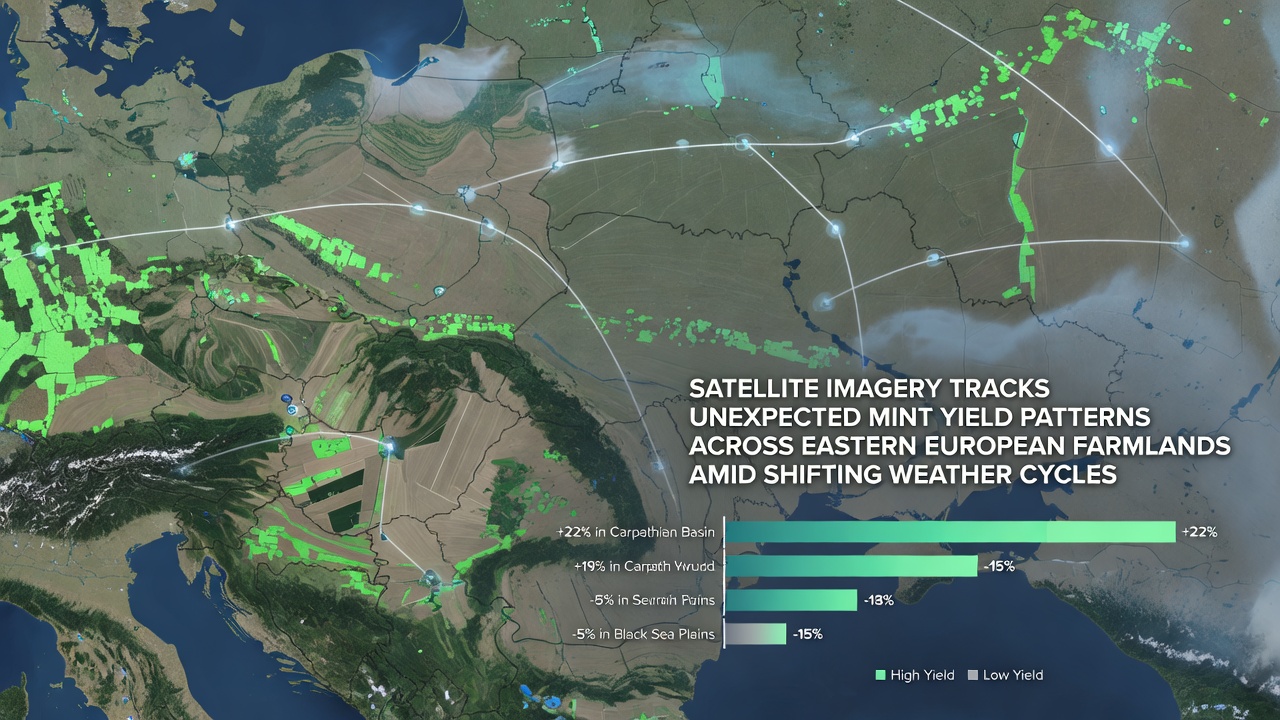
Researchers tracking agricultural output through orbital sensors have documented irregular mint production rates across parts of Poland, Hungary and Romania where traditional growing cycles once followed predictable seasonal rhythms. Data collected from multiple satellite platforms reveal patches of elevated biomass in zones previously flagged for drought stress while neighboring fields show reduced leaf density despite adequate rainfall totals.
Data Collection Methods and Platforms
Agencies operating the Copernicus Sentinel-2 constellation supply multispectral readings that allow calculation of vegetation indices such as NDVI and EVI on weekly intervals throughout the growing season. These measurements combine with ground station records from national meteorological services to produce maps that highlight deviations from multi-year averages. Analysts at several Eastern European institutes cross-reference the orbital datasets with soil moisture probes and local harvest reports to confirm the spatial patterns observed from space.
One team examining imagery from the 2025 season noted that certain river valley plots in eastern Hungary maintained higher chlorophyll levels into late summer even as surrounding upland areas declined. Similar anomalies appeared in Romanian districts along the Danube tributaries where cooler night temperatures coincided with unexpected yield increases. The combination of factors points to microclimate influences that satellite resolution now captures at field scale.
Weather Cycle Influences on Crop Performance
Longer dry spells punctuated by intense rainfall events have become more common in the region according to records compiled by the European Environment Agency. Mint, which prefers consistent moisture without waterlogging, responds to these shifts in ways that vary by cultivar and soil type. Satellite time series show that fields with deeper root zones retained productivity while shallower soils experienced sharp drops during heat waves recorded in July and August 2025.
Yet some areas recorded above-average leaf biomass following moderate autumn rains that arrived earlier than historical norms. Observers note that these late-season boosts appear in locations where previous drought had limited weed competition, allowing mint stands to expand rapidly once moisture returned. The pattern repeats across multiple satellite passes from September through November 2026, suggesting a recurring dynamic tied to altered precipitation timing rather than total annual rainfall.

Regional Variations and Ground Verification
Polish monitoring stations in the Greater Poland Voivodeship reported harvest weights that aligned closely with satellite-derived estimates in 70 percent of sampled parcels during the most recent campaign. Discrepancies occurred mainly in fields where recent irrigation upgrades altered canopy development after the final satellite overpass. Hungarian agronomists working with the same imagery found stronger correlations in rain-fed plots and weaker matches where supplemental water sources masked underlying weather effects.
Researchers continue to refine algorithms that separate mint signals from surrounding row crops through higher-resolution commercial satellite layers. These efforts have reduced classification errors and allowed more precise tracking of unexpected yield clusters that emerge under shifting climate conditions. Ground crews collect tissue samples and moisture readings at selected sites to calibrate the models each season.
Implications for Monitoring and Planning
National agricultural ministries now incorporate the satellite products into early warning systems that alert growers to developing stress zones weeks before visible symptoms appear in the field. The approach supports targeted interventions such as adjusted irrigation schedules or variety selection for the following planting window. Data from the November 2026 analysis cycle indicate that certain eastern Romanian districts may benefit from earlier autumn sowing dates to capitalize on the observed late-season moisture windows.
International organizations including the Food and Agriculture Organization have referenced similar orbital monitoring techniques in reports covering temperate herb production. The methods developed for mint offer transferable frameworks for other high-value aromatic crops facing comparable weather variability across Central and Eastern Europe.
Conclusion
Orbital monitoring continues to supply consistent records that document how mint responds to evolving weather patterns across Eastern European farmlands. The datasets highlight both challenges and localized opportunities that emerge when precipitation timing and temperature ranges deviate from long-term averages. Ongoing integration of satellite observations with field measurements provides growers and planners with updated information for season-to-season decision making.